How Burial Vaults Are Made: A Complete Guide to Materials, Process, and Choices

Most people only think about a burial vault once, when a funeral director mentions it during arrangements. Yet this heavy, carefully engineered container plays a big role in every traditional burial. If you've ever wondered how burial vaults are made, what they're made of, and whether you really need one, this guide walks through it all, from the factory floor to the graveside.
Whether you're a family making arrangements, a funeral professional, or simply curious, you'll come away understanding how burial vault construction works and how to choose wisely.
Watch the Full Video Guide
What Is a Burial Vault?
A burial vault is an outer container that surrounds the casket in the grave. The casket is lowered into the vault, and a heavy lid is sealed on top. Its main jobs are to:
- Support the weight of the earth and the heavy equipment that drives over cemetery grounds, so the grave doesn't cave in or sink
- Keep the ground level, which makes cemeteries safer for visitors and easier to mow and maintain
- Add a layer of protection around the casket from soil and water
Because of the first two reasons, most cemeteries in the United States require some kind of outer burial container.
Burial vault vs. grave liner
You'll often hear two terms, and they aren't the same thing:
- Grave liner: A basic concrete box (sometimes just sections, or open at the bottom) that keeps the ground from settling. It is not sealed and isn't designed to keep water out. It's usually the least expensive option.
- Burial vault: A fully enclosed container with a sealed lid, typically lined with plastic or metal. It costs more and is designed to resist water and soil intrusion.
If your cemetery requires an "outer burial container," a grave liner often satisfies the rule. Ask the cemetery exactly what they accept before choosing.
What Burial Vaults Are Made Of
The materials largely determine a vault's strength, weight, and price:
- Reinforced concrete: The backbone of most vaults. Concrete is reinforced with steel rebar, mesh, or fibers so it can carry enormous loads without cracking.
- Plastic and polymer liners: Molded liners (commonly ABS or polypropylene) are bonded to the inside of the concrete to add a moisture barrier and a smooth, clean interior.
- Metal liners: Premium vaults bond copper, bronze, or stainless steel to the concrete. These metals resist corrosion and give the vault a more finished, upscale look.
- All-metal vaults: Some vaults are made primarily of steel or other metals rather than concrete.
- Sealants and coatings: Butyl or asphalt-based sealants join the lid and base, and exterior coatings help protect the outer surface.
How Burial Vaults Are Made: Step by Step
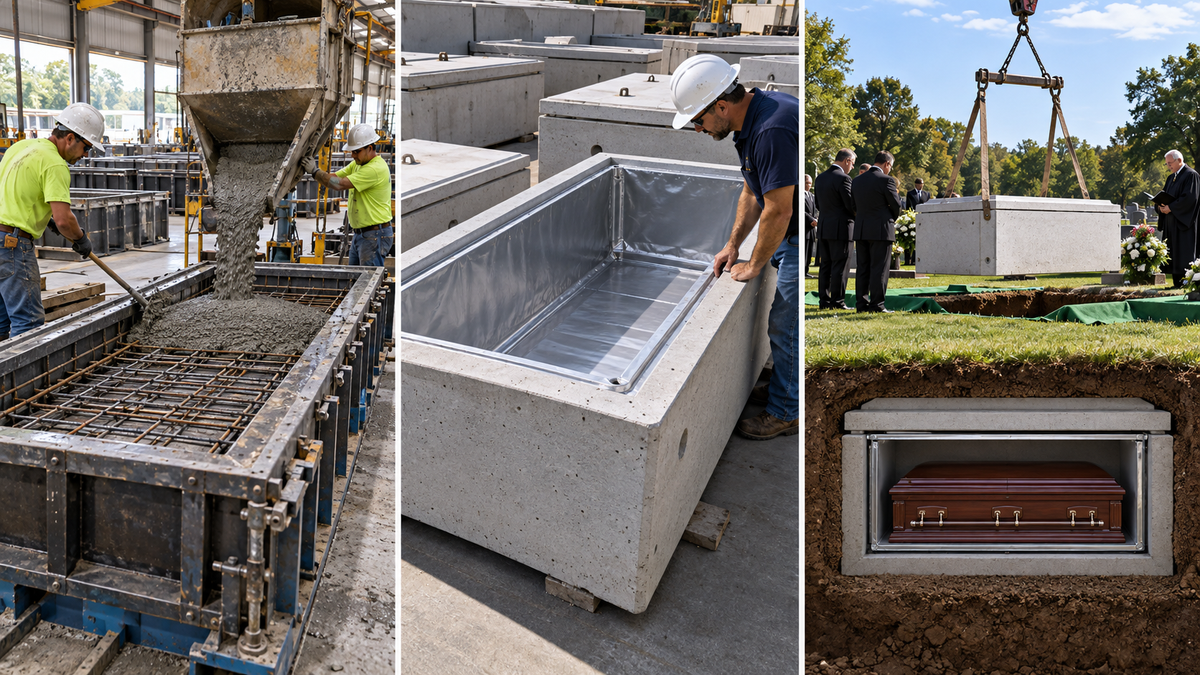
Most vaults today are concrete vaults built in a precast plant. Here's how the process typically works:
- Preparing the forms. Heavy steel forms (molds) that define the vault's shape and size are cleaned and coated with a release agent so the concrete won't stick.
- Placing the liner and reinforcement. For lined vaults, the plastic or metal liner is set into the form first so the concrete will bond directly to it. Steel reinforcement is positioned to strengthen the walls, floor, and lid.
- Mixing the concrete. A high-strength mix of cement, sand, gravel or crushed stone, and water is batched, sometimes with additives that improve strength and water resistance.
- Pouring and vibrating. Concrete is poured into the forms and vibrated to release trapped air bubbles, which helps create a dense, strong structure with fewer weak spots.
- Curing. The concrete is left to set and harden under controlled conditions. Forms can often be removed after about a day, but concrete keeps gaining strength over the following weeks.
- Finishing and decorating. The exterior may be coated or painted, and lids can be finished with colors, emblems, nameplates, or religious, military, or personal designs.
- Quality inspection. Each vault is checked for cracks, voids, and proper fit between lid and base before it ships.
- Sealing at the graveside. The final seal happens at the cemetery. After the casket is lowered into the vault, the lid is placed on top. Many designs use a tongue-and-groove joint lined with sealant to lock the lid in place.
For metal vaults, the process is different: metal sheets are cut, formed, and welded, then finished with protective coatings.
Types of Burial Vaults Compared
| Type | Construction | What to Know |
|---|---|---|
| Grave liner | Concrete, unsealed | Lowest cost; prevents settling but doesn't keep water out |
| Lined concrete vault | Reinforced concrete with plastic/polymer liner | The most common choice; sealed lid and added moisture barrier |
| Metal-lined concrete vault | Concrete with bonded copper, bronze, or stainless steel | Premium option with corrosion-resistant lining and decorative finishes |
| Metal vault | Primarily steel or other metal | Lighter than concrete; durability depends on metal and coating |
| Urn vault | Smaller concrete, plastic, or metal container | Holds a cremation urn when ashes are buried; some cemeteries require one |
What Do Burial Vaults Cost?
Prices vary widely by region, material, and design. As a rough guide, a basic grave liner may cost several hundred dollars to around $1,500, while sealed burial vaults commonly range from about $1,000 to several thousand dollars, with premium metal-lined models costing more. Delivery and graveside setup may be included or listed separately, so always ask for an itemized price.
Know Your Rights When Buying a Vault
- No state law requires a vault. Outer burial container requirements come from individual cemetery rules, not state law. Under the Federal Trade Commission's Funeral Rule, funeral providers can't tell you otherwise.
- You're entitled to prices up front. Funeral homes must provide an outer burial container price list (or include the prices on their general price list) before showing you vaults.
- Be wary of preservation promises. No vault can preserve remains forever, and providers aren't allowed to claim that a vault's protective features will.
- You may have choices. Ask whether the cemetery accepts a grave liner instead of a sealed vault, and whether you can buy from another seller.
Choosing the Right Burial Vault
- Start with the cemetery's rules. Find out what they require and whether a grave liner is acceptable.
- Consider the site. Areas with high water tables or heavy clay soil are where a sealed, lined vault may matter more to families.
- Think about your priorities. Some families want the most basic option; others value added protection or a decorative lid for the graveside service.
- Ask about personalization. Many manufacturers offer lid colors, emblems, and nameplates, including military and religious designs.
- Consider green burial. If you'd rather not use a vault at all, natural burial grounds typically don't allow them or permit only open-bottom alternatives.
Frequently Asked Questions
How long does it take to make a burial vault?
Concrete vaults can often be removed from their forms within about a day, but they continue to cure and gain strength for weeks. Most vaults are made in advance and kept in inventory, so families usually don't wait for one to be produced.
Are burial vaults required by law?
No state law requires a burial vault. However, many cemeteries require an outer burial container, either a vault or a grave liner, to keep graves from sinking.
How much does a burial vault weigh?
Concrete vaults are very heavy and often weigh well over a ton, which is why they're placed with special equipment at the cemetery.
Can burial vaults be personalized?
Yes. Many vaults offer custom lid colors, emblems, nameplates, and designs reflecting faith, military service, hobbies, or personal interests.
Do I need a vault for cremated remains?
Some cemeteries require an urn vault when burying ashes, while others don't. Check with the cemetery.
Quick Tips (Short Videos)
Listen to the Podcast Episode
Prefer to listen? This episode of The Funeral Channel Podcast covers how burial vaults are made and what families should know before choosing one.
More Resources
- Watch the complete video guide on YouTube.
- Read the full support article.
- Learn more about burial vaults and body disposition.
- Visit The Funeral Program Site for funeral planning resources.
- Browse our YouTube playlist for more videos on burial and funeral planning.
Final Thoughts
A burial vault is one of the least visible parts of a funeral, but a great deal of engineering goes into it. From steel-reinforced concrete and bonded liners to the sealed lid placed at the graveside, each step is designed to keep the grave stable and add protection. Knowing how vaults are made, and your rights when buying one, helps you choose with confidence, whether you select a simple grave liner, a premium lined vault, or no vault at all in a natural burial ground.
About the Author: Christi Anderson is the founder of The Funeral Program Site and The Funeral Channel Network, and a published author dedicated to helping families navigate funeral planning and end-of-life traditions with compassion and clarity.