History of Halloween: A Complete Guide to Its Ancient Rituals and Modern Traditions

Every October, millions of people carve pumpkins, pull on costumes, and fill bowls with candy. Yet the history of Halloween runs far deeper than its modern trappings. Long before plastic skeletons and candy corn, this was a night for honoring ancestors, marking the turn of the seasons, and acknowledging the thin line between life and death. In this complete guide, we trace Halloween from ancient Celtic fires to medieval church feasts to today's neighborhood trick-or-treating, and we look at why a holiday rooted in remembrance still resonates so strongly.
Watch the Full Video Guide
Ancient Origins: The Celtic Festival of Samhain
Halloween's story begins more than 2,000 years ago with Samhain (pronounced "SOW-in"), a festival observed by the Celtic peoples of Ireland, Scotland, and surrounding regions. Samhain fell at the end of October and marked the close of the harvest and the start of the dark, cold half of the year. For communities whose survival depended on the land, this was a critical turning point: crops were gathered, livestock brought in from summer pastures, and stores set aside for winter.
Samhain was also believed to be a time when the boundary between the world of the living and the world of the dead grew thin. Spirits of the departed were thought to return to their homes, and other, less friendly beings might roam freely. To mark the occasion, communities lit great bonfires, and households are often said to have extinguished their hearth fires and relit them from the communal flame, a symbol of renewal and protection heading into winter.
Many traditions associated with Samhain, such as disguising oneself to avoid being recognized by wandering spirits, are recorded more clearly in later Irish and Scottish folk customs than in ancient sources. Still, the core idea is consistent: Samhain was as much about honoring and remembering the dead as it was about fearing them. Families set places at the table and left food out for ancestors, a practice that echoes in remembrance traditions around the world today.
Roman and Christian Influences Shape Halloween
When the Roman Empire conquered much of Celtic territory in the first century, Roman customs mingled with local ones. The Romans observed Feralia, a late-February day to honor the dead, and celebrated Pomona, the goddess of fruit and orchards, whose symbol was the apple. Some historians suggest that this Roman influence is one source of apple-centered games like bobbing for apples, though the connection is debated. What is clear is that, over centuries, the autumn season in these lands became layered with many cultures' ideas about harvest, death, and remembrance.
The biggest transformation came with Christianity. In the 8th century, Pope Gregory III designated November 1 as All Saints' Day, also known as All Hallows' Day, to honor saints and martyrs. Later, November 2 became All Souls' Day, dedicated to praying for all the faithful departed. The evening before All Hallows' Day became All Hallows' Eve, a name that gradually contracted into "Hallowe'en" and then Halloween.
Together, these three days, often called Allhallowtide, formed a season centered on the dead. Medieval customs such as "souling," in which the poor went door to door offering prayers for the dead in exchange for small "soul cakes," are widely seen as an ancestor of modern trick-or-treating. Bells were rung, candles were lit for departed loved ones, and graves were visited and tended.
Halloween's Journey to America
Halloween arrived in North America largely with European immigrants, most notably the Irish, who came in great numbers during and after the potato famine of the 1840s. Scottish immigrants also carried their own Halloween customs across the Atlantic. In their new home, these traditions blended with American harvest festivities, ghost stories, and fortune-telling games.
By the late 1800s, community leaders and newspapers encouraged families to shift Halloween away from pranks and superstition and toward neighborly gatherings and parties. Through the early 20th century, Halloween became a community celebration with parades, costume contests, and harvest socials. Trick-or-treating as we know it spread widely in the United States in the late 1940s and 1950s, as postwar suburbs filled with children and candy makers embraced the holiday.
Today, Halloween is one of the biggest celebrations of the American year, with elaborate costumes, haunted houses, decorated homes, and festive gatherings for every age.
| Era | Key Halloween Traditions | Connection to the Dead |
|---|---|---|
| Ancient Celtic | Samhain bonfires, disguises, harvest feasts | Spirits of ancestors believed to return home |
| Roman | Feralia, Pomona and apple symbolism | Feralia set aside to honor the departed |
| Medieval Christian | All Saints' Day, All Souls' Day, souling and soul cakes | Prayers, candles, and grave visits for loved ones |
| Modern America | Trick-or-treating, costumes, parties, haunted houses | Ghosts, skeletons, and graveyard themes |
The Story Behind Halloween's Most Famous Symbols
Jack-o'-Lanterns
The jack-o'-lantern comes from Irish folklore about "Stingy Jack," a man who tricked the devil and was doomed to wander the earth with only a coal inside a hollowed-out turnip to light his way. In Ireland and Scotland, people carved faces into turnips and other root vegetables to ward off wandering spirits. When the tradition reached America, the native pumpkin proved larger and far easier to carve, and it quickly became the Halloween icon we know.
Costumes
Disguises connect back to the idea that dressing up could confuse or hide from spirits roaming on this night. Later, "guising" in Scotland and Ireland saw young people in costume going house to house performing songs, poems, or jokes in exchange for treats, a direct forerunner of modern costumed trick-or-treating.
Black and Orange
Halloween's signature colors are commonly linked to its roots: orange for the autumn harvest and bonfires, and black for the darkness of the coming winter and for death itself.
Ghosts, Skeletons, and Graveyards
The holiday's spooky imagery is a playful echo of its original purpose. Beneath the decorations lies a centuries-old tradition of acknowledging mortality and remembering those who came before us.
Modern Traditions and Global Celebrations
Halloween is now celebrated in many countries, each adding its own flavor. In the United States and Canada, costumes, trick-or-treating, and haunted attractions dominate. In Ireland, where many of Halloween's roots lie, bonfires, traditional games, and barmbrack (a fruit bread baked with small charms that are said to predict the future) remain popular. In Scotland, guising continues alongside more modern celebrations.
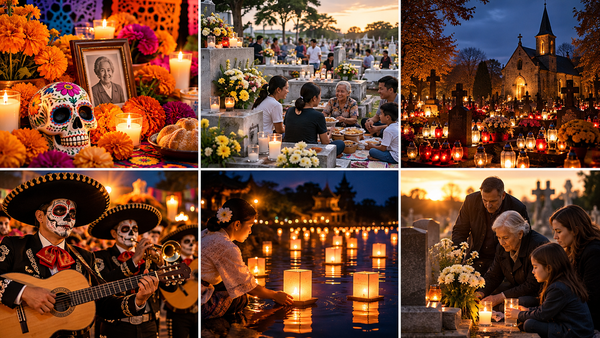
Halloween is often mentioned alongside Mexico's Día de los Muertos (Day of the Dead), though the two are distinct holidays. Día de los Muertos, observed November 1 and 2, blends Indigenous Mexican traditions with Catholic All Saints' and All Souls' Days. Families build ofrendas (altars) decorated with marigolds, candles, photographs, and favorite foods of loved ones who have passed, and gatherings are joyful rather than frightening. Many countries also observe All Souls' Day with candlelit cemetery visits, a quiet reminder of the remembrance at the heart of this season.
Halloween as a Season of Remembrance
For all its fun, Halloween's deepest roots are about memory. Samhain welcomed ancestors home, All Souls' Day called for prayers for the departed, and Día de los Muertos celebrates loved ones with color and warmth. Many families today carry that spirit forward by lighting a candle, sharing stories, displaying photos, or visiting the graves of those they've lost during this time of year.
If you are planning a memorial service, celebration of life, or a remembrance gathering in the fall, the season's themes of harvest, light, and honoring ancestors can offer meaningful inspiration. The Funeral Program Site offers templates and resources to help you create a fitting tribute, and our YouTube channel playlist is full of ideas, tutorials, and remembrance traditions.
Fun Facts About Halloween
- The first jack-o'-lanterns in Ireland and Scotland were carved from turnips and other root vegetables, not pumpkins.
- The word "Halloween" is a contraction of "All Hallows' Eve," the evening before All Saints' Day.
- Medieval "soul cakes," exchanged for prayers for the dead, are considered an early ancestor of trick-or-treating.
- Halloween ranks among the biggest consumer holidays in the United States, with billions spent each year on candy, costumes, and decorations.
- Black and orange are Halloween's traditional colors, symbolizing death and the harvest.
Halloween in Pop Culture
Halloween's reach extends well beyond October 31. Films such as "Halloween," "Hocus Pocus," and "The Nightmare Before Christmas" have become seasonal staples, while classic literature like Washington Irving's "The Legend of Sleepy Hollow" helped shape America's spooky autumn imagination. Today, the season inspires everything from haunted house attractions and themed festivals to home décor, family traditions, and quiet evenings spent remembering loved ones.
Frequently Asked Questions About the History of Halloween
Where did Halloween originate?
Halloween traces back to Samhain, an ancient Celtic festival in Ireland and Scotland marking the end of the harvest and the beginning of winter, later blended with Christian All Hallows' traditions.
Why is it called Halloween?
The name comes from "All Hallows' Eve," the night before All Saints' Day (All Hallows' Day) on November 1.
Is Halloween the same as Día de los Muertos?
No. They fall close together and both relate to the dead, but Día de los Muertos is a separate Mexican tradition, celebrated November 1 and 2, focused on joyfully honoring departed loved ones.
How did trick-or-treating start?
It grew from older customs like medieval souling and Scottish and Irish guising, and it became widespread in the United States in the mid-20th century.
Explore More: Videos and Podcast Resources
For a deeper dive into the history of Halloween, watch our comprehensive video guide. Short on time? These quick videos cover the essentials: Halloween Origins in 60 Seconds and Why Do We Carve Pumpkins?
Quick Tips (Short Videos)
Read the full support article
View the Google Doc version
Conclusion
The history of Halloween is a story of transformation: a Celtic harvest festival that welcomed ancestors home, a Christian season of prayer for the departed, and an immigrant tradition that grew into one of America's most beloved celebrations. Whether you're carving a pumpkin, dressing up, or lighting a candle for someone you miss, you're taking part in a tradition that has honored life, death, and memory for more than two thousand years. Embrace the spirit of the season, and celebrate its rich heritage in your own way. Happy Halloween!