Burial Vaults vs Urn Vaults: A Complete Guide to Choosing the Right Protection for Your Loved One

When planning a final resting place, families are often faced with the decision between burial vaults vs urn vaults. Understanding the differences, purposes, and requirements for each can help you make the best choice for your loved one's memorial. In this complete guide, we'll break down what sets these two types of vaults apart, when each is needed, what they're made of, how much they typically cost, and how to select the right one for your family's needs and your cemetery's requirements.
Watch the Full Video Guide
What Are Burial Vaults?
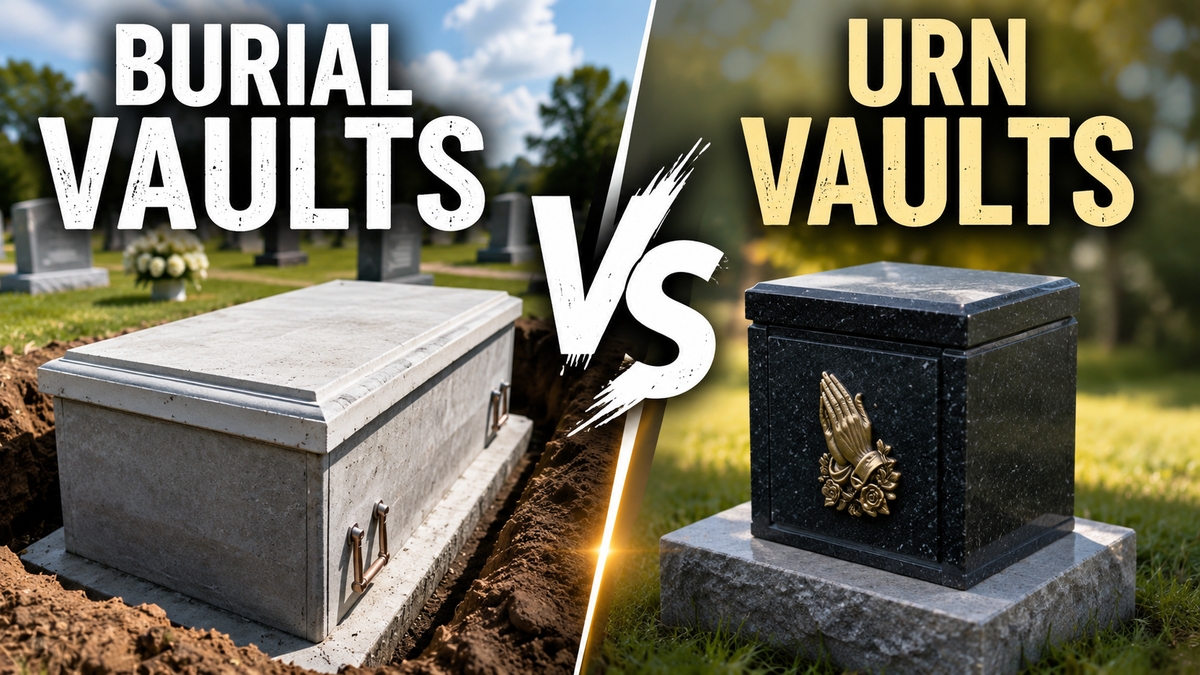
Burial vaults are outer containers designed to encase a casket when it is buried in the ground. Their main function is to protect the casket from the weight of the earth and heavy cemetery equipment, as well as to prevent the ground from settling or collapsing over time. Most cemeteries require burial vaults for traditional casket burials to maintain the integrity of the gravesite and keep the surrounding lawn level for mowing and maintenance.
- Materials: Typically made from reinforced concrete, metal, or high-strength plastic. Concrete is the most common and budget-friendly option, while metal vaults (often stainless steel, copper, or bronze) tend to offer better sealing and a higher price point.
- Size: Large enough to fit a standard casket, generally sized to accommodate the outer dimensions of most casket models.
- Purpose: Structural protection and preservation of the burial plot, and in many cases, a slower rate of decomposition thanks to a sealed design.
What Are Urn Vaults?
Urn vaults serve a similar purpose as burial vaults but are specifically designed for cremation urns. They protect the urn from soil pressure and environmental elements, ensuring the burial site remains undisturbed. Many cemeteries require urn vaults for in-ground cremation burials to prevent ground settling and maintain a neat, level appearance across the cemetery grounds.
- Materials: Concrete, polymer, or metal, with polymer options often chosen for their lighter weight and lower cost.
- Size: Compact, sized to fit one or more urns depending on the model, making them a practical choice for couples or family plots.
- Purpose: Protects the urn and the integrity of the burial plot, while also offering a small measure of personalization since urn vaults are easier to customize than their larger counterparts.
Burial Vaults vs Urn Vaults: Key Differences
| Feature | Burial Vault | Urn Vault |
|---|---|---|
| Intended Use | Casket Burial | Cremation Urn Burial |
| Size | Large (fits casket) | Small (fits urn) |
| Material | Concrete, Metal, Plastic | Concrete, Polymer, Metal |
| Cemetery Requirement | Often Required | Often Required |
When Is Each Vault Needed?
Most cemeteries have regulations regarding the use of vaults. Traditional casket burials almost always require a burial vault, while cremation burials may require an urn vault depending on the cemetery's policies. Some cemeteries allow cremated remains to be buried without any vault at all, particularly in dedicated cremation gardens or scattering areas, while others enforce the same standards used for full-body burials. Always check with your cemetery before making a purchase to ensure compliance with their rules, since requirements can vary significantly not just by state but by individual cemetery or memorial park.
How to Choose Between a Burial Vault and an Urn Vault
Consider these factors when deciding between burial vaults vs urn vaults:
- Type of Burial: Is your loved one being buried in a casket or as cremated remains? This is usually the deciding factor before any other consideration comes into play.
- Cemetery Regulations: What does your chosen cemetery require? Ask for their vault policy in writing before purchasing, since some cemeteries only accept vaults sourced through their own approved vendors.
- Budget: Burial vaults are generally more expensive due to their size and materials, while urn vaults tend to be a more affordable option for cremation burials.
- Personalization: Both types of vaults can be customized with engravings, colors, or emblems, allowing families to add a meaningful personal touch.
- Longevity & Sealing: If long-term preservation matters to your family, ask about sealed versus unsealed vault options, as sealed vaults typically offer stronger protection against moisture and ground shifting.
Frequently Asked Questions
- Can you use an urn vault for a casket? No, urn vaults are too small for caskets and are designed specifically for urns.
- Are burial vaults required by law? No federal or state law requires burial vaults, but most cemeteries do for maintenance reasons.
- Can multiple urns be placed in one urn vault? Some urn vaults are designed to hold more than one urn. Always check the product specifications.
- Do vaults prevent decomposition entirely? No vault stops decomposition completely, but sealed vaults can significantly slow the process compared to unsealed options.
- Can a vault be purchased in advance? Yes, many families choose to pre-plan and pre-purchase vaults as part of broader end-of-life arrangements.
Expert Insights: Video and Podcast Resources
For a more in-depth look at burial vaults vs urn vaults, watch our detailed video guide or explore our YouTube Channel for additional resources.
Quick Tips (Short Videos)
Additional Resources and Support
For more information and support on burial vaults vs urn vaults, visit our brand resource page. You can also view the Google Doc version of this article for a concise summary. For the most comprehensive support, read the full support article.
Conclusion
Choosing between a burial vault and an urn vault is a significant part of memorial planning. By understanding the differences and requirements, you can make a decision that honors your loved one's wishes and meets all cemetery guidelines. Taking the time to ask the right questions upfront — about materials, sealing, cemetery policy, and budget — can spare your family added stress during an already difficult time. If you have further questions, explore our resources or reach out to our team for personalized assistance.